Shop TRQ on 1AAuto.com
Wheel Bearing & Hub Assembly
Wheel Bearing & Hub Assembly Set
Shop TRQ on Amazon
Wheel Bearing & Hub Assembly
Wheel Bearing & Hub Assembly Set
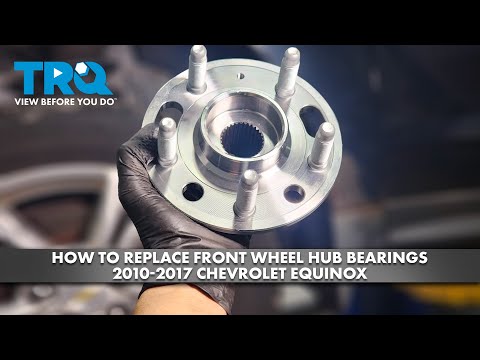
This video shows you how to install new front wheel bearing & hub assemblies from TRQ on your 2010-2017 Chevrolet Equinox. Not only can a worn wheel bearing or hub be annoying if it is noisy or vibrating, but it can also lead to accelerated wear in other parts, or unsafe driving conditions. Replacing your worn bearing or hub with a quality TRQ part is a safe, smart, decision.
This repair was done on a 2015 Chevrolet Equinox LT 3.6L Sport Utility 4-Door AWD Automatic and the process should be similar on the following vehicles:
2010 Chevrolet Equinox
2011 Chevrolet Equinox
2012 Chevrolet Equinox
2013 Chevrolet Equinox
2014 Chevrolet Equinox
2015 Chevrolet Equinox
2016 Chevrolet Equinox
2017 Chevrolet Equinox
Tools you will need:
• Pry Bar
• 13mm Socket
• 18mm Socket
• 22mm Socket
• 36mm Socket
• 1/2 Inch Impact Gun
• 3/8 Inch Impact Gun
• T30 Socket
• Ratchet
• Socket Extensions
• Swivel
• Torque Wrench
• Anti-Seize Grease
• Gloves
• Rust Penetrant
• Safety Glasses
• sanding disc
• Floor Jack
• Hammer
• Jack Stands
Subscribe:
Check out our playlist:
Chevy Equinox 2010-2017 2nd Gen:
📱 Download the TRQ Auto Repair App for more videos, torque specifications, and car repair information:
⚠ DISCLAIMER:
While TRQ strives to make the information provided in this video as accurate as possible, it makes no claims, promises, or guarantees about the accuracy, completeness or applicability of the content. No information contained in this video shall create any expressed or implied warranty or guarantee of any particular result. All do-it-yourself projects entail some risk. It is the sole responsibility of the viewer to assume this risk. TRQ is not responsible or liable for any loss damage (including, but not limited to, actual, consequential, or punitive), liability, claim, or any other injury or cause related to or resulting from any information posted in this video.
√ Watch the Video
√ Buy The Part at 1A Auto https://1aau.to/m-Shop-TRQ-Parts
√ Do it Yourself
√ Save Money
140 torque for lug nuts??? I looked it up and everything I find is 100 torque lbs. 140 seems a bit too much… just my opinion.
Awesome step by step video but I will say that it always looks easy in these videos. I have found in the northern states it takes a bit more to get the hub assembly off. Be patient.
Did anybody ever teach you about galvanic corrosion. what is it that you are using for anti-seize would that be 99% copper anti-seize. Do you know what happens when you apply copper onto an aluminum surface with electrical charge running through it.
When someone coats an aluminum hub with a copper-based anti-seize that contains about ninety-nine percent copper, the main issue is galvanic corrosion. Copper and aluminum sit far apart on the galvanic scale. When they’re pressed together with moisture and an electrolyte present—rainwater, road salt, condensation—the aluminum becomes the anode and corrodes faster.
A few things follow from that.
The aluminum surface oxidizes aggressively. That oxide layer grows unevenly and can cause the hub or bore to seize despite the presence of the compound. The copper particles in the paste effectively create a conductive path that accelerates the galvanic reaction. This can make removal of the wheel or component harder over time instead of easier.
The copper residue can also imprint into the aluminum surface under torque. This alters the local surface hardness and can cause galling or pitting during future disassembly. The material loss can lead to distortion around the mating surface.
Copper anti-seize also raises the local thermal conductivity in an uneven way. On brake components, that can cause temperature gradients around the hub-to-rotor interface. It’s not usually catastrophic, but it’s not ideal.
If the hub is torque-critical—like a wheel hub, rotor hat, or bearing carrier—manufacturers typically specify an aluminum- or nickel-based anti-seize instead. Those compounds minimize galvanic mismatch.
In short, the aluminum corrodes faster, the mating surfaces degrade, and long-term serviceability can get worse instead of better. The surrounding context of your project might open up a few interesting angles on preventing galvanic escalation.